June 10, 2026
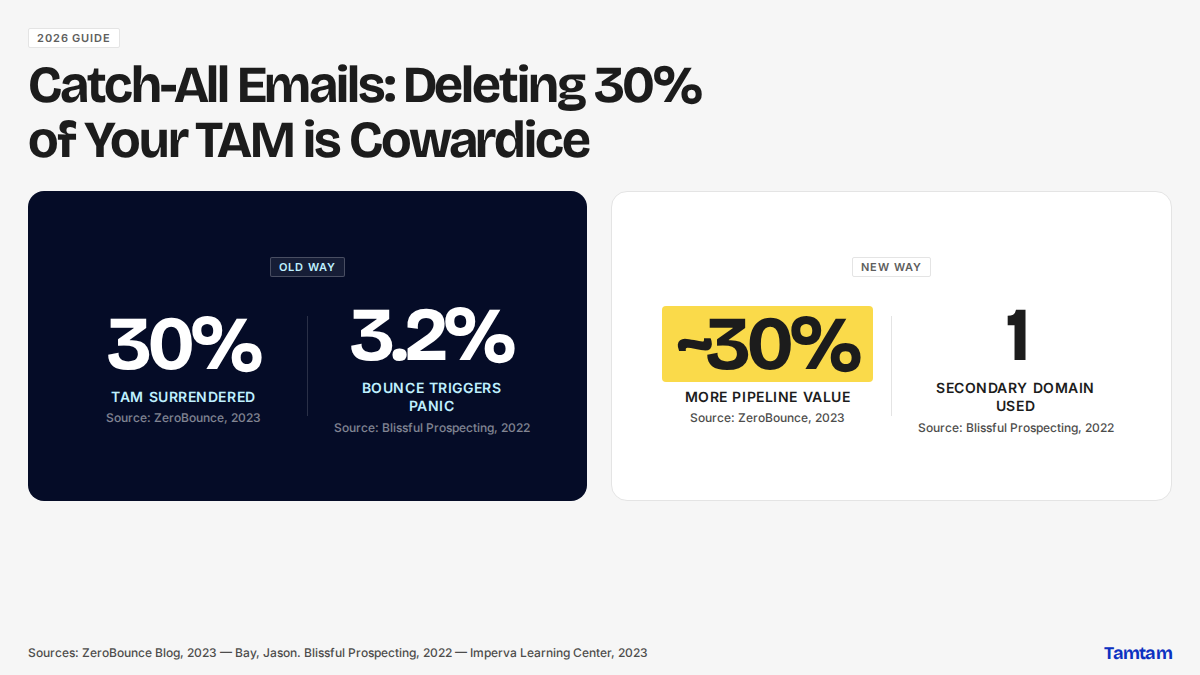
Catch-all emails are not junk; they are intentional security moats designed by your most valuable enterprise prospects to filter out lazy outreach. Deleting them means you're voluntarily surrendering up to 30% of your total addressable market out of fear. This anxiety is often driven by RevOps teams who prioritize clean spreadsheets over closing major deals. Instead of running scared, adopt a smarter strategy by isolating catch-alls on a secondary domain and engaging them with offers so valuable they can't be ignored.
You've sat in this meeting. I know you have.
The RevOps manager, armed with a color-coded dashboard, points to a scary-looking spike on a line graph. "Our bounce rate ticked up to 3.2% this week," they announce, with the gravity of an air traffic controller reporting a missing engine. "The main culprit: catch-all addresses. Our domain reputation is at risk."
The CRO, who just spent the morning staring at a pipeline report that looks like a ghost town, sighs. They know the company needs to hit bigger accounts to make the quarter. They also know that fighting the Process Police is a battle they will probably lose.
So, they give in. "Fine. Scrub the list. Delete all unverifiable and catch-all contacts."
And just like that, thousands of potential leads from your most-desired enterprise accounts vanish into the digital ether. Another win for the spreadsheet-jockeys. Another loss for the people actually responsible for generating revenue.
You’ve been told this is a technical problem. A simple matter of "deliverability" and "risk management."
That is a comforting lie.
The debate over catch-all emails has almost nothing to do with technology. It’s a proxy war for the soul of your sales organization. It’s a litmus test that reveals whether you are building a culture of calculated aggression or a culture of timid compliance. Are you in the business of hunting whales, or are you in the business of keeping your HubSpot data tidy?
Because you can't do both.
First, let's get one thing straight. A catch-all email server is not an accident. It's not a sign of a sloppy, misconfigured system.
It is a fortress.
A catch-all server is a deliberate, intelligent security measure implemented by a competent IT department. Its primary job is to accept all mail sent to a domain, regardless of what comes before the "@" symbol. This means emails to blahblahblah@corp.com or sales.guy.is.annoying@corp.com won't immediately bounce. They get routed to a general inbox or a specific admin.
Why would any sane IT director do this? To stop you. Or, more specifically, to stop the brute-force bots and spammers you get lumped in with.
The technical term for one of the main threats is a Directory Harvest Attack (DHA). This is where spammers use software to blast a domain with millions of common email permutations (john.smith@, j.smith@, jsmith@, smith.j@...). Every "bounce" tells them an address is invalid. Every delivery confirms a valid employee email, which they can then add to their spam lists or sell on the dark web.
A catch-all server is the digital equivalent of a castle moat. By accepting everything, it gives the attacker zero feedback. The spam bot can't tell which emails are real and which are fake, rendering its attack useless. Some companies even set up "tarpits," which intentionally slow down the connection from suspected attackers, trapping their bots in a sticky, time-wasting mess.
So, when your verification tool flags an address as a "catch-all," it's not telling you the lead is bad. It's telling you the lead works at a company that is smart enough and valuable enough to actively defend itself from digital noise.
It's a signal of sophistication. A marker of a high-value target. And your company’s default policy is to turn around and run away from it.
So if these catch-all domains are where the big fish live, why is your organization so terrified of them?
The answer lies in a fundamental, and frankly idiotic, misalignment of incentives. It’s a civil war playing out in slow motion inside your go-to-market team.
On one side, you have the sales team. They are compensated on one thing: closed-won revenue. Their job is to bring money into the building. They need to talk to high-level decision-makers at large, complex organizations. The very organizations that use catch-all servers.
On the other side, you have the RevOps or Sales Ops team. They are often measured and bonused on process purity. Their KPIs sound like a robot's diary: CRM data integrity, lead routing efficiency, email bounce rate, domain sender score. Their job is to de-risk the process, not to generate revenue.
See the problem?
When a RevOps manager sees a 3% bounce rate, they don't see an acceptable cost of doing business to reach Fortune 500 executives. They see a personal failure. A red mark on their performance review. A threat to their meticulously organized system.
Their incentive is to eliminate every possible variable, every speck of dust. And a catch-all email is the ultimate variable. It might be the CEO, or it might get routed to a spam folder. The uncertainty is unacceptable. To a person whose job is to create certainty, the only logical move is to delete the threat.
This creates the perfect corporate paradox. A company can hit a flawless 0.8% bounce rate across all its email campaigns and miss its revenue target by 40%. The RevOps team gets a bonus for their pristine deliverability score while the sales team gets laid off for underperforming.
They've successfully protected the ship from ever hitting a wave by refusing to leave the harbor. It’s safe. It’s clean. And it's completely damn useless.
Look, the RevOps team isn't entirely wrong. Blindly blasting thousands of catch-all addresses from your primary domain is a stupid, amateurish move. That’s how you get your domain blacklisted and cripple your entire company's ability to send email, from marketing newsletters to password resets.
But the opposite extreme, deleting what ZeroBounce estimates is around 30% of all B2B email addresses, is an act of strategic surrender.
The professional move, the one that your competitors are too scared or too lazy to make, is to do neither. The solution isn't to choose between safety and aggression. It's to be intelligently aggressive.
Here’s how you storm the castle.
This is Deliverability 101, yet it’s amazing how few teams do it. Don't send high-volume or high-risk campaigns from your main corporate domain (mycompany.com).
Instead, buy a few secondary domains that are slight variations (mycompany.io, getmycompany.com, trymycompany.com). Warm them up properly over a few weeks with a tool that automates the process. These are your "battle" domains. They are expendable.
Segment your lists. All your verified, high-confidence emails go out from the primary domain. All your catch-all, high-value enterprise targets get contacted from your secondary domains. If a secondary domain’s reputation takes a hit, who cares? You can rest it and warm up another. Your core corporate domain remains untouched, pristine, and safe.
You’ve just surgically isolated the technical risk. Problem solved.
The real reason people fear catch-alls isn’t the bounce; it’s the silence. They fear the email will land in a general info@ inbox, be ignored by an admin, or get deleted without a thought.
And you know what? If you’re sending a generic, self-serving pitch about your "award-winning, paradigm-shifting platform" that you copied and pasted to 200 people, you deserve to be ignored.
The only way to penetrate a fortress is with a battering ram of pure, undeniable value. You can't send a generic pitch. You have to send an "offer" so compelling that whoever receives it feels compelled to forward it to the right person.
Jason Bay of Blissful Prospecting tells a great story about this. A rep was trying to get into Patagonia. All the verification tools failed. So, instead of giving up, the rep walked into a Patagonia store, took pictures, and built a detailed teardown of their in-store customer experience with actionable ideas for improvement. He sent it to a catch-all address. The value was so obvious and so potent that it got routed internally to the right executive, who responded immediately and booked a meeting.
The message was so good, the address didn't matter. That is the standard. If your outreach to a catch-all address isn't that good, don't send it. The risk isn’t your domain reputation. The risk is that you're sending boring, worthless crap that deserves to be ignored.
The strategies above solve the technical and tactical problems. But they don’t solve the root cause: your company is measuring the wrong thing. As long as RevOps has a KPI for "bounce rate," they will always fight you on catch-alls.
You have to change the metric. This is the CRO’s job.
Stop reporting on activity metrics like bounce rates in your executive meetings. Start reporting on business outcomes, segmented by risk. For example: "Our outbound to verified SMB contacts generated $50k in pipeline this month with a 1.2% bounce rate. Our strategic outbound to enterprise catch-all contacts generated $400k in pipeline with a 4.5% bounce rate."
Which number do you think the board cares about?
Frame the conversation around pipeline per segment, not deliverability purity. Make it clear that a slightly higher bounce rate is not a technical failure; it is the calculated, acceptable cost of hunting whales. When the company celebrates the revenue from those enterprise accounts, nobody is going to give a damn about the bounce rate.
You break the civil war by giving both sides a shared definition of victory, and that victory is always, always pipeline. Not a clean dashboard.
Look, the Jason Bay story isn't about being a creative genius. It's about having a damn good reason to show up. That's the real moat-killer. You can't fake that kind of relevance by just writing a clever sentence; it comes from knowing precisely why this account needs to hear from you right now. That’s not a creative writing problem, it’s a data problem. You win by dissecting your past victories to find the patterns, the real triggers, that tell you a castle is ready for a siege. It’s the difference between guessing and knowing, and it’s what platforms like Tamtam are built to solve.
Set up for you before our first call
Book a demo