June 9, 2026
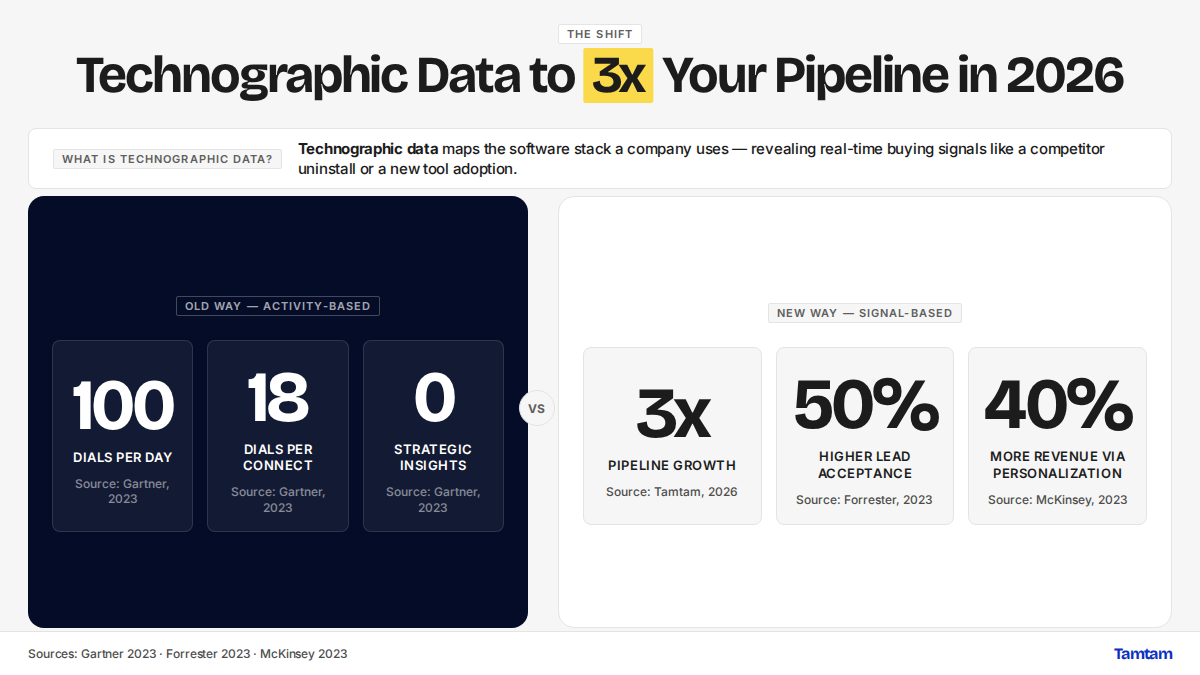
Stop rewarding sales activity like 100 dials a day; it's a mathematically bankrupt strategy that burns your market. Instead, build your prospecting around your buyers' tech stack by identifying 'golden signals', events like a competitor uninstall or a complementary tech install that prove acute pain. Use these triggers to craft a hyper-relevant point of view, not a generic pitch. This is how you stop playing a numbers game and start winning the relevance game.
Your sales floor is probably addicted to a drug that’s killing your business: the daily dial count.
We tell our reps to be consultative, to build relationships, to be trusted advisors. Then we give them powerful technographic data, one of the richest layers of B2B data: tools that show exactly what software their prospects use, and we manage them on… “100 dials a day.”
This is like handing a Navy SEAL a state-of-the-art sniper rifle and grading them on bullets fired per minute.
It’s a catastrophic misalignment of tools and incentives. It guarantees you burn through your best leads, annoy the hell out of your total addressable market, and turn your most ambitious reps into demoralized robots. It’s time to fix it.
This guide will show you how to use technographic data the right way. Not as another column in a spreadsheet to fuel more cold calls, but as a strategic weapon to find buyers with a burning problem and approach them with an actual solution.
Before you even think about technographics, you have to perform an exorcism. You have to cast out the demon of activity-based KPIs.
Why this matters: Forcing your reps to hit "100 dials a day" or "500 emails a week" actively punishes them for doing the very thing that closes deals: thinking. A rep who spends 15 minutes researching a company's tech stack to find a killer insight is a rep who is now 15 minutes behind on their dial count. Your compensation plan is literally paying them not to be strategic.
You incentivize them to become human auto-dialers, blasting through your TAM and annoying the 99% of people who aren't ready to buy, all to find the 1% who might be. Gartner reports it takes an average of 18 dials just to connect with a single buyer. This "100-Dial Graveyard" is a soul-crushing, zero-ROI reality created by managers obsessed with the illusion of control that comes from a dashboard full of green activity bars.
What to do: Immediately stop managing your team on raw activity metrics. They are proxies for what you actually want, so just measure what you actually want.
Replace them with outcome-based metrics that reward intelligence, not brute force. For example:
This shifts the focus from "Did you work hard?" to "Did you work smart?"
A common mistake to avoid: Fearing your reps will just stop working. The shift isn't to zero accountability; it's to accountability for results. When you show a rep that 10 highly targeted, well-researched calls produce more commission than 100 blind dials, they don't get lazy. They get hungry. They start hunting for better signals, not just dialing for dollars.
Technographic data on its own is mostly useless noise. Knowing a company uses Salesforce is like knowing they have a building with electricity. It’s a starting point, but it tells you nothing about their immediate needs.
Why this matters: You need to graduate from static attributes to dynamic signals. A real signal is an event. It’s a moment in time when something changes in their tech stack, signaling an opportunity, a pain, or a strategic shift. Focusing on these events concentrates your team's firepower on accounts that are experiencing a verifiable problem right now. A 2023 Forrester report found that sales teams using buying-intent data see a 50% higher lead acceptance rate. That's the power of timing.
What to do: Work with your sales, marketing, and product teams to map out the 3 to 5 key technographic events that scream "they need us." These are your "golden signals."
Here are a few classic examples:
A common mistake to avoid: Building a static list and calling it a day. Technographic data has a half-life. A list of "companies that use HubSpot" from six months ago is a historical document, not an actionable prospecting list. Your targeting must be based on real-time events. The value isn't in knowing what they have, but in knowing what they just did.
Once you have a golden signal, you've earned the right to have an opinion about your prospect's business. Your outreach should lead with that opinion, not with a request for 15 minutes.
Why this matters: Nobody on earth wants to hear another generic sales pitch. Your prospect's inbox is a graveyard of "quick questions" and pitches that start with "thought you might be interested in." They don't want a pitch; they want help solving a problem they're staring at right now.
Leading with a signal-based observation does two things instantly:
This is the difference between being ignored and being seen as relevant. And relevance prints money. Recent research from McKinsey confirms that companies excelling at personalization generate 40 percent more revenue from those activities than their average-performing peers.
What to do: Use the golden signal to form a sharp, insightful hypothesis about the prospect's challenge or opportunity. Lead with it.
Let's look at the difference.
Generic Pitch (Bad):
"Hi Jane, I see your company uses Marketo. I sell a tool that helps marketing teams like yours generate more MQLs. Do you have 15 minutes to connect this week?"
This is awful. It’s all about you and what you sell. Jane has already archived it.
Point of View (Good):
"Hi Jane, noticed on your careers page that you're hiring three new Marketo admins. Congrats on the growth.
Usually when I see teams scale their marketing automation that quickly, the next big challenge is keeping their lead scoring model from breaking under the new volume.
Have you considered how you'll maintain lead quality as you triple the inputs?"
See the difference? The second one isn't a pitch. It’s a professional observation that demonstrates expertise and leads with the prospect's likely problem. You're starting a business conversation, not begging for a slot on their calendar.
With great data comes great responsibility. Using technographic signals is a powerful way to be relevant, but it's a short walk from "relevant" to "creepy digital stalker."
Why this matters: Abusing data is the fastest way to destroy trust and get your domain blacklisted. Buyers have a hard boundary. Crossing it doesn't just lose you one deal; it can damage your company's reputation and make it harder for your entire team to operate. Professional context is seen as helpful research. Personal snooping is seen as manipulation.
What to do: Use a simple framework: if the prospect would have to ask, "How the hell did they know that?" you’ve probably crossed the line. Stick to public, professional data that a diligent person could find.
Safe / Surprising (Good): "Saw your company just uninstalled [Competitor Tech]. That must be a massive project. Often, the big challenge after a migration like that is [related problem you solve]."
Clumsy (Okay, but not great): "I saw you downloaded our whitepaper on B2B marketing. Let's talk."
Creepy (Bad): "I saw on your personal network you took your kids to the lake last weekend. Hope you had a great time! Anyway, about our software…"
A common mistake to avoid: Thinking all personalization is good personalization. Mentioning the college they went to or their favorite sports team is a classic amateur move. Unless you have a genuine, non-creepy connection to it, it just signals desperation. And for the love of god, stop CC'ing their entire executive team on your first email. It doesn’t make you look important; it makes you look like a spammer who doesn't know who to talk to.
The old debate between quality and scale in prospecting is officially dead. AI killed it. You no longer have to choose between sending 1,000 terrible emails or 10 perfect ones.
Why this matters: A single, AI-augmented rep can now do the strategic work of three manual reps. They can achieve deep, signal-based personalization at a scale that "spray and pray" could never dream of. This is how you 3x to 5x your pipeline velocity without tripling your headcount and burning out your team.
What to do: Implement tools and systems that automate the most robotic parts of the job: monitoring for signals and drafting the initial outreach. This reframes the SDR's role entirely. They are no longer copy-pasters and human dialers. They are editors, strategists, and business consultants who review, refine, and deliver AI-generated insights.
Think of it as creating a team of "Technographic Snipers." An AI system monitors your target accounts 24/7. When it detects a golden signal, like a competitor uninstall, it cross-references it with hiring data and recent company news. It then generates a draft email that includes a sharp point of view based on that specific context.
Your rep’s job is to spend three minutes reviewing that draft, editing it for tone and nuance, and then sending a perfect, context-aware message. They might only send 20 of these a day, but they'll book more meetings than the rep next to them making 100 blind calls.
The strategy is sound, but the execution is a damn nightmare for a human. Manually tracking these golden signals across thousands of accounts is impossible. By the time your rep finds a competitor uninstall, the window has closed. The sheer volume of research is why most teams give up and revert to brain-dead call lists. A platform like Tamtam is built to absorb that chaos, automating the hunt for the specific buying triggers that are unique to your best customers. It turns this entire strategic guide into a daily hit list of accounts that have all but raised their hand.
Set up for you before our first call
Book a demo